

Yes. Entry is free and an independent visit is realistic if you are comfortable choosing shops and trying a phrase or two. A guide is most useful when you want interpretation, a planned route, and included tastings.
Most Tsukiji guides start with price. A better question is: what would you need a guide to do for you?
Entry to the Tsukiji Outer Market is free. You can walk its lanes, choose shops and buy food without joining a tour. What a good tour can add is interpretation: someone selects a route, explains what you are seeing, manages the pace and turns a crowded market into a series of conversations and tastings.
So before you book anything, learn these six phrases and think about the kind of visit you want.
- If you are comfortable choosing shops, pointing and trying a phrase or two, a self-guided visit is realistic.
- If you want someone to explain the food, plan the route and handle most of the communication, an English-guided food tour may be worth the cost.
- If you are undecided, let your time, diet and appetite for planning decide.
The goal is one useful exchange—not perfect Japanese.
Tsukiji is also approachable for English-speaking visitors. The market’s official shopping guide says some people working there speak English, and the Plat Tsukiji information center offers English-language assistance. English is not guaranteed at every shop, but you can still visit independently without fluent Japanese: use English where it works, point when needed and treat the phrases below as conversation starters—not an entrance requirement.
Six useful Japanese phrases for Tsukiji
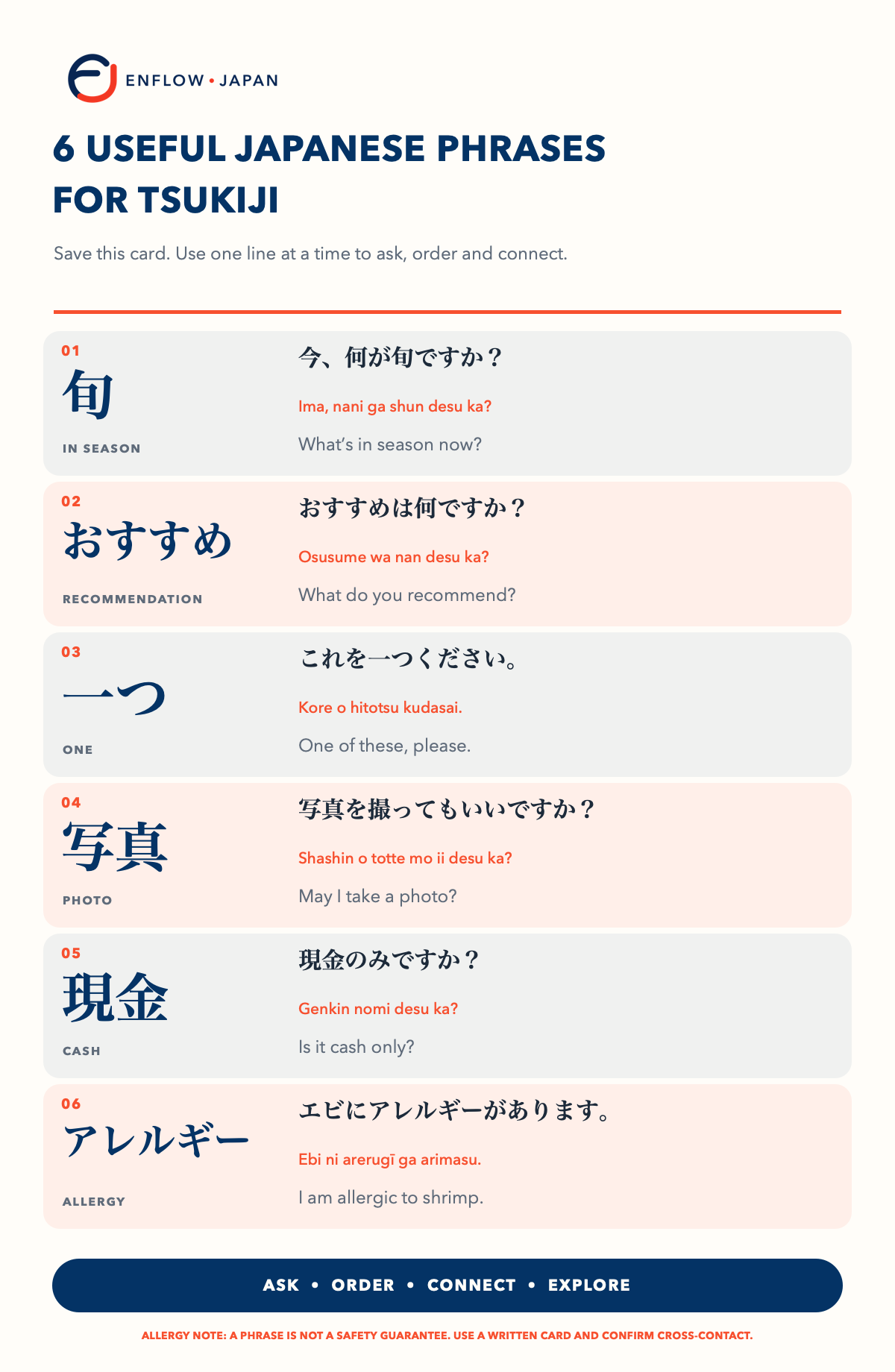
Six phrases at a glance: 旬 (in season), おすすめ (recommendation), 一つ (one), 写真 (photo), 現金 (cash), and アレルギー (allergy).
Save the phrase card and choose the lines that fit your visit. Here is what each phrase changes on the ground.
1. 旬 — ask what is in season
今、何が旬ですか? Ima, nani ga shun desu ka? “What’s in season now?”
The kanji 旬 (shun) means the time when an ingredient is in season. It is a more interesting opening than asking for “the best” item, because the answer can change by shop and month.
The official Japanese Tsukiji guide highlights seasonal produce and says shop staff can advise customers about ingredients, selection and preparation. You may not understand every word in the reply; pointing, a price label and the staff member’s gesture can still turn the question into a real choice.
2. おすすめ — ask for a recommendation
おすすめは何ですか? Osusume wa nan desu ka? “What do you recommend?”
This is the most reusable phrase in the set. The Japan Foundation’s official IRODORI Japanese course teaches the same question in a restaurant-ordering context.
Do not assume “recommended” means cheapest, most famous or allergy-safe. It means you have invited the person behind the counter to suggest something. Check the price and ingredients before agreeing.
3. 一つ — order one
これを一つください。 Kore o hitotsu kudasai. “One of these, please.”
Point to the item as you say これ (kore, “this”). Japanese has different counters for different shapes and objects, but 一つ (hitotsu, “one”) is a useful beginner form for many simple purchases.
If the item is sold only by pack, tray or portion, the shop may show you the actual unit. Look at the displayed quantity and price before paying.
4. 写真 — ask before taking a photo
写真を撮ってもいいですか? Shashin o totte mo ii desu ka? “May I take a photo?”
This phrase is not optional etiquette at Tsukiji. The market’s official guidance asks visitors to get the shopkeeper’s permission before photographing a shop, and some shops prohibit photography.
Ask first, wait for a clear yes and keep the camera away from workers and other customers if they have not agreed.
5. 現金 — check how to pay
現金のみですか? Genkin nomi desu ka? “Is it cash only?”
The official shopping guide says card acceptance varies by shop and that most shops accept Japanese yen only. Bring some yen rather than assuming every stall will take a foreign card or phone payment.
If you prefer to ask about your card directly, use カードは使えますか? (Kādo wa tsukaemasu ka?), meaning “Can I use a card?”
6. アレルギー — state an allergy
エビにアレルギーがあります。 Ebi ni arerugī ga arimasu. “I am allergic to shrimp.”
Replace エビ (ebi) with the ingredient you need to avoid. The Japan Foundation’s official restaurant lesson uses allergy language as a reason someone cannot eat a dish.
But this phrase is not an allergy guarantee. It does not confirm that staff understood the severity, that every ingredient was identified or that cross-contact can be prevented. For a serious allergy:
- Carry a written allergen card in Japanese.
- Ask about sauces, stock and shared cooking surfaces.
- Get written confirmation from a tour provider before booking.
- Do not eat when the answer is unclear.
How to choose between a tour and going solo
Language is only one part of the tour-versus-solo choice. Compare the experience you want before deciding.
Choose a guided tour for English explanation, a fixed route, planned tastings and cultural context. Go self-guided for flexibility, a smaller budget and the freedom to choose only what you want.
A tour does not buy admission to Tsukiji. The market itself is open to independent visitors. You are paying for the guide, route, explanations and included food.
A simple self-guided Tsukiji plan
The official visitor window is generally 9:00 a.m. to 2:00 p.m. Individual shops keep their own hours and closing days, and many close on Sundays or some Wednesdays.
Try this route:
- Arrive around 9:00 a.m., after the professional-buyer priority period.
- Start at the Plat Tsukiji information center for a map and English assistance.
- Walk one lane before buying anything.
- Ask one shop 今、何が旬ですか?
- Ask another おすすめは何ですか?
- Buy one item with これを一つください。
- Eat at the shop or its designated space—not while walking.
- Finish with ありがとうございます (Arigatō gozaimasu, “Thank you”).
The market also asks visitors to avoid large luggage, move in small numbers, give working buyers room, never touch food for sale and not bargain.
When the checked tour is a sensible alternative
The exact option rechecked for this guide is Tsukiji Fish Market Food Tour: Seafood, Street Food & Hidden Gems, product code 87037P6, supplied by Ninja Food Tours through Viator.
At the July 23 check, the listing showed:
- approximately 2 hours 30 minutes;
- English offered;
- full-lunch-size tastings at five or more vendors;
- a maximum of six travelers;
- a 9:00 a.m. start;
- a meeting point in front of Lawson Tsukiji 4-chome;
- free cancellation up to 24 hours before the experience; and
- a “not wheelchair accessible” label.
With July 31, 2026 and two adults selected, the live result still showed this exact product at “from ¥13,800.” That is dated, pre-checkout context—not a guaranteed price. Your date, traveler count, currency, inventory and checkout screen control the actual total.
The listing asks travelers to message food restrictions at least one week before the tour and says last-minute food requests cannot be accommodated. It also says vegan, vegetarian and gluten-free options are limited.
Reviews on the product page point in both directions: many travelers praise the guide’s explanations and the amount or variety of food, while one reviewer felt the surrounding market area was enjoyable but was unsure a tour was necessary. That is exactly why the decision should depend on the service you need, not the rating alone.
Three checks before you book
- Confirm the live product. Match the title and product code 87037P6.
- Confirm the limitations. Ask in writing about allergies, mobility, substitutions and the current meeting instructions.
- Confirm the expectation. This is a Tsukiji food route. Do not assume it includes the Toyosu tuna auction unless your live booking page and voucher explicitly say so.
The wholesale inner market moved from Tsukiji to Toyosu in 2018. The Tsukiji Outer Market remains active with roughly 460 shops, but it is not the Toyosu wholesale-market auction.
The answer
Go solo if the phrase card makes you feel curious rather than anxious. You do not need fluent Japanese, and Plat Tsukiji can provide English assistance.
Book a guided tour if the real value for you is English interpretation, a fixed route and a planned meal—not access to the market itself.
Either way, use at least one phrase. 旬 is not just a word to memorize; it is an invitation to ask what is good today.
Follow ENFLOW JAPAN for practical Japan travel guidance checked against Japanese primary sources.
Sources checked
Where the key facts came from
Official market and language sources are separated from marketplace details. All were re-opened on Jul 23, 2026 JST.