

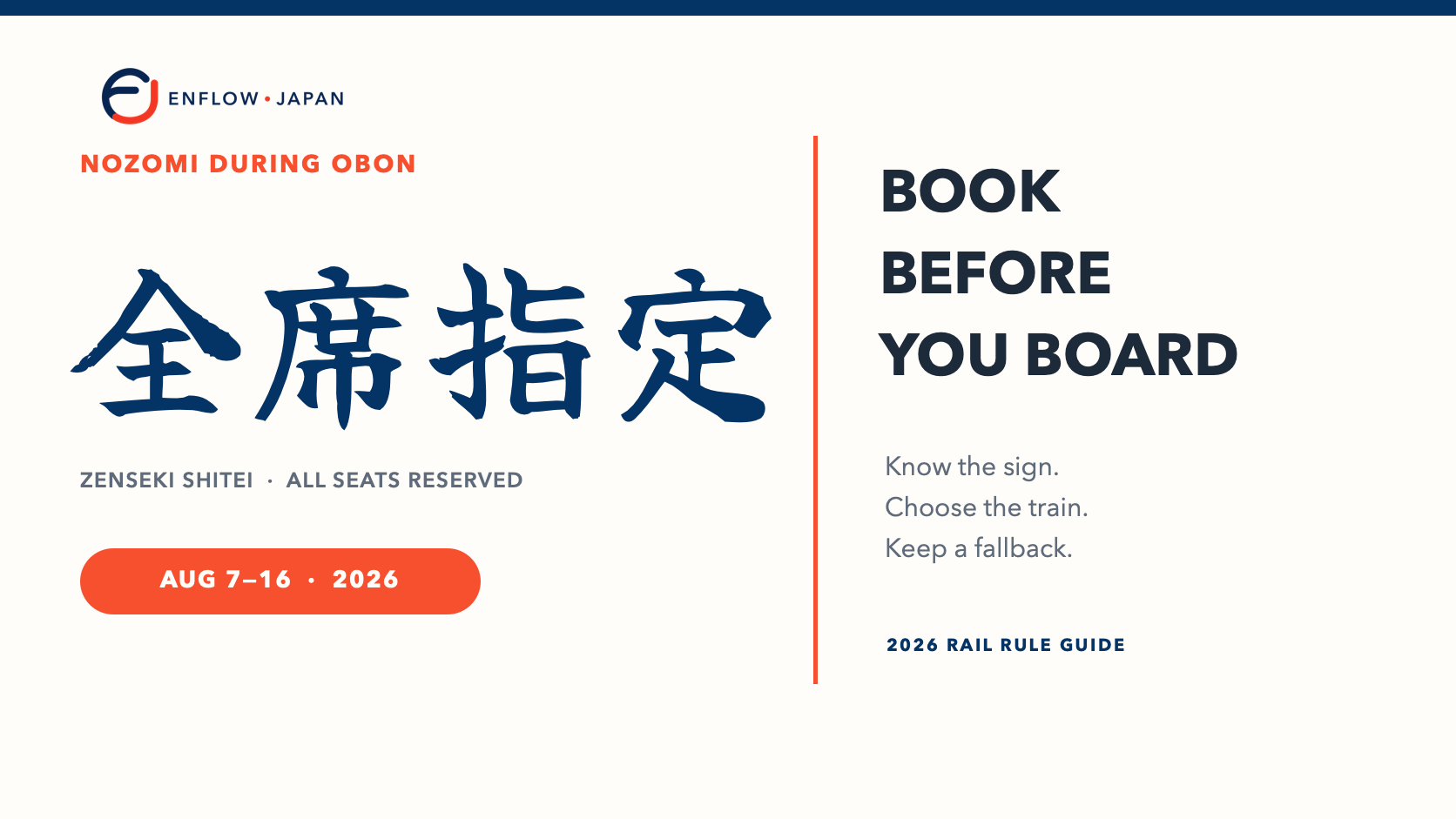
Every Nozomi is all-reserved from Aug 7–16, 2026. Book the exact train if you want a seat; other listed Shinkansen keep non-reserved cars, but crowded alternatives are not a guaranteed fallback.
If your Japan itinerary includes a Nozomi between Tokyo, Nagoya, Kyoto, Shin-Osaka, Hiroshima or Hakata from August 7 through 16, 2026, do not arrive expecting to find a non-reserved car.
During those ten days, every Nozomi on the Tokaido and Sanyo Shinkansen is 全席指定 (zenseki shitei): all seats are reserved.
That does not mean every Shinkansen is all-reserved. Hikari, Kodama, Mizuho, Sakura and Tsubame keep their normal non-reserved seating. Those cars can still be crowded, so a reservation is the safer plan when your route allows one.
The useful decision is simple:
- If your itinerary names a Nozomi and you want to sit, reserve that exact train before boarding.
- If the Nozomi you want is full, search a different time or date before treating standing as a solution.
- If you use a JAPAN RAIL PASS, do not assume Nozomi is included. The pass needs a separate Nozomi/Mizuho ticket, or you need an eligible alternative train.
As of July 25, the normal one-month sales date has passed for every travel day in this August 7–16 window. This is a booking task for now, not something to leave on an arrival-day checklist.
What exactly changes from August 7 to 16?
Nozomi normally has non-reserved seating in cars 1 and 2. During the 2026 Obon period, those cars change to reserved seating.
The rule covers every Nozomi operating between Tokyo and Hakata. For a visitor, that includes common Nozomi trips such as:
- Tokyo to Nagoya;
- Tokyo to Kyoto;
- Tokyo to Shin-Osaka;
- Shin-Osaka to Hiroshima; and
- longer journeys that continue toward Hakata.
The operator's reason is capacity management during one of Japan's busiest travel periods. More passengers can hold an assigned seat before reaching the platform, and long queues for a small non-reserved section are reduced.
The date boundary matters. The all-reserved rule applies to Nozomi journeys from Friday, August 7 through Sunday, August 16, 2026. Do not apply it to an August 6 or August 17 train without checking that train's own seat display.
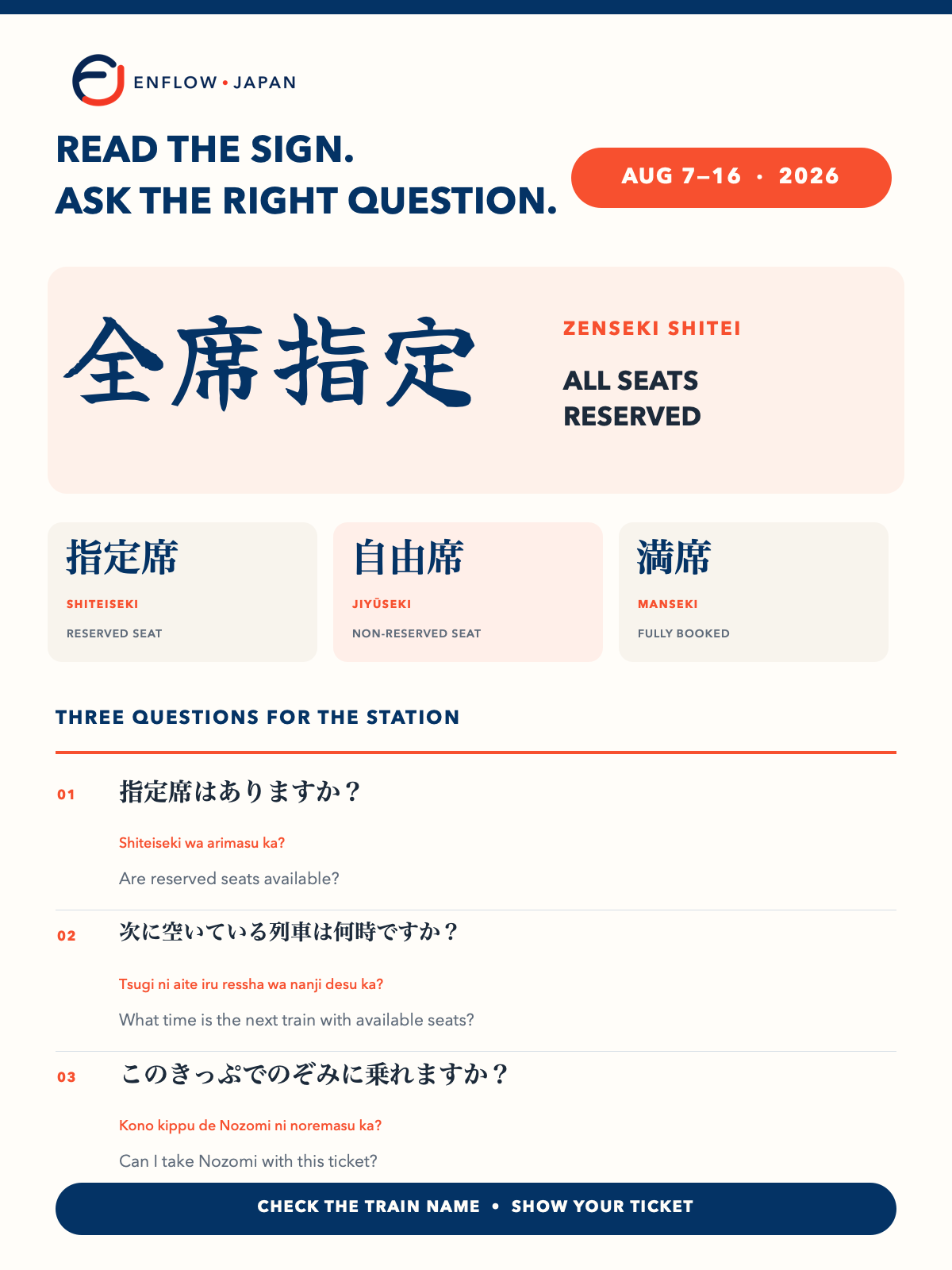
Read the sign: 全席指定
You may see 全席指定 on a booking screen, departure display or service notice.
- 全 (zen) — all
- 席 (seki) — seat
- 指定 (shitei) — designated or assigned
Together, 全席指定 means all seats are reserved.
Three related terms make the booking screen easier to read:
指定席 — shiteiseki — reserved seat
This is a seat assigned to a particular train, car and seat number.
自由席 — jiyūseki — non-reserved seat
You choose an available seat inside the designated non-reserved cars after boarding. 自由 means freedom; it does not mean the seat is free of charge.
満席 — manseki — fully booked
If a train shows 満席, that train has no reservable seats in the displayed category. It does not prove that every train that day is full.
Three questions that turn the words into action
The point is not to pass a language test. Use one sentence when it helps a station employee solve the right problem.
指定席はありますか?
Shiteiseki wa arimasu ka? “Are reserved seats available?”
Show the employee your route and travel date while asking. A seat may be available on a different departure even when your first choice is full.
次に空いている列車は何時ですか?
Tsugi ni aite iru ressha wa nanji desu ka? “What time is the next train with available seats?”
This asks for the next workable train, not just whether the current one is full.
このきっぷでのぞみに乗れますか?
Kono kippu de Nozomi ni noremasu ka? “Can I take Nozomi with this ticket?”
Use this when you have a rail pass, a non-reserved ticket or a multi-leg ticket and are unsure what it covers. The answer depends on the exact ticket, so show it rather than relying on a generic rule remembered from social media.
Book now: the 10-minute plan
1. Confirm the train name, not just the route
“Tokyo to Kyoto by Shinkansen” is not enough information. Check whether the selected service is Nozomi, Hikari or Kodama.
If it is Nozomi on August 7–16, select a reserved seat. If you are comparing alternatives, compare the actual departure and arrival times rather than assuming every Shinkansen takes the same time.
2. Use an official booking path
JR Central lists these ways to buy a reserved seat:
- Tokaido Sanyo Kyushu Shinkansen Online Reservation, including SmartEX;
- relevant JR company online reservation services;
- a reserved-seat ticket machine;
- a JR station ticket counter; or
- a participating travel agency.
Standard reserved seats go on sale at 10:00 a.m. one month before departure. The official online service also offers a limited set of products and seats up to one year ahead, under separate conditions.
If you booked more than one month ahead, read the confirmation carefully. The official guide says the final train number, times and seat number are normally confirmed after 8:00 a.m. one month before travel.
3. Reserve for the whole group
Do not assume people who buy separately will be placed together. The official online service can handle multiple travelers in one booking, subject to availability.
If sitting together matters more than a particular departure, search nearby times before accepting separated seats.
4. Check large luggage before choosing the seat
On the Tokaido, Sanyo and Kyushu Shinkansen, baggage with combined dimensions from 160 cm through 250 cm requires a seat reservation with an oversized baggage area.
That luggage rule is separate from the Obon Nozomi rule. During a busy period, the right seat type can be more limited than an ordinary reserved seat, so do not add the baggage requirement at the station as an afterthought.
If the Nozomi you want is full
Use this order:
- Search an earlier or later Nozomi.
- Check whether moving the trip to a different day is realistic.
- Compare a reserved Hikari or Kodama for the route.
- If only non-reserved seating remains on an alternative service, allow extra time and accept that a seat is not guaranteed.
- Ask station staff to confirm what your existing ticket permits before entering the gate.
JR's official guidance allows a passenger with the relevant non-reserved limited-express ticket to stand on an ordinary-car deck of Nozomi. But it also says overcrowding may prevent boarding the desired train.
That makes standing an emergency rule, not a travel strategy. It is especially weak for a family, a group that wants to stay together, anyone with mobility needs, or a traveler carrying large luggage.
“You may be allowed to stand” and “you have a workable trip” are not the same promise.
If you have a JAPAN RAIL PASS
A national JAPAN RAIL PASS does not cover Nozomi or Mizuho by itself.
To use Nozomi, a pass holder must separately buy the official [ONLY WITH JAPAN RAIL PASS] NOZOMI MIZUHO Ticket for the relevant journey and use it with a valid pass. That ticket has its own availability limits.
Your practical choices are:
- reserve an eligible Hikari or Kodama under the conditions of your pass; or
- buy the separate Nozomi/Mizuho ticket and reserve the required seat.
Do not use an empty seat on a Nozomi booking screen as proof that the pass-holder add-on is available. The official pass page says its allocated seats can be unavailable even when open seats appear elsewhere.
Regional JR passes have different coverage. Check the exact pass name rather than applying the national JAPAN RAIL PASS rule to every product with “JR” in its title.
If you miss your reserved Nozomi
JR Central's peak-period guide says that, on the same day, the reserved limited-express ticket can be used to:
- stand on the ordinary-car deck of a later Nozomi; or
- use a non-reserved seat on Hikari, Kodama, Mizuho, Sakura or Tsubame.
To sit in a reserved seat on a later Nozomi, you need a new reserved-seat limited-express ticket.
Ticket combinations can be complicated. Take the actual ticket or booking screen to staff and ask:
このきっぷでのぞみに乗れますか? Can I take Nozomi with this ticket?
If the train is tied to an airport arrival or another uncertain connection, leave enough time before the reservation. A faster Nozomi does not save time if the plan gives you no safe way to reach it.
The one-screen checklist
Before August 7:
- [ ] Check whether your selected train is Nozomi.
- [ ] Reserve the exact departure if you want a seat.
- [ ] Confirm every traveler's car and seat number.
- [ ] Check the separate Nozomi rule if using a JAPAN RAIL PASS.
- [ ] Reserve an oversized-baggage seat if required.
- [ ] Save the booking details where they work without mobile data.
- [ ] Note one earlier or later train you could ask about if plans change.
At the station, look for:
- 全席指定 — all seats reserved
- 指定席 — reserved seat
- 自由席 — non-reserved seat
- 満席 — fully booked
The answer
For August 7–16, 2026, treat a Nozomi seat as something you choose before you reach the platform.
The rule is narrow but important: every Nozomi between Tokyo and Hakata is all-reserved. Other listed Shinkansen services keep non-reserved seating, but their crowded cars are not a guaranteed fallback.
Learn 全席指定, reserve the exact train if you want a seat, and ask for the next train with availability rather than building the day around a standing exception.
If this guide prevented a station surprise, save the phrase card and read ENFLOW JAPAN's other practical guides.
Sources checked
Where the key rules came from
Railway rules are taken from operator and JR Group sources. Traveler discussions informed the questions, not the facts. All sources below were reopened on Jul 25, 2026 JST.