

Yes—if you start early, choose three anchors, and leave enough yoyū for a delay. Stay overnight for onsen and slower time; hire a guide for interpretation and adaptive navigation.
Yes, Hakone can be a day trip from Tokyo. The official Hakone guide publishes a one-day loop, and Odakyu presents the Hakone Freepass as useful even when you do not stay overnight.
But “possible in one day” is not the same as “put every famous stop into one day.”
The more useful question is whether your plan has 余裕 (yoyū): enough time, attention and calm to absorb a delay without losing the part of Hakone you came to enjoy.
Use that word to make three decisions:
- Go independently for the lowest cost and the most freedom.
- Stay one night if onsen, quiet evenings or unhurried museums are central to the trip.
- Consider a licensed guide if navigating the loop and understanding what you see matter more than complete independence.
The goal is not to “finish” Hakone. It is to build a day that can still work when the mountain does not follow your spreadsheet.
The Japanese idea: 余裕 means more than spare minutes
余裕 is read yoyū. Depending on context, it can mean leeway, spare capacity, composure or room to spare.
For a Hakone day trip, a useful English rendering is breathing room.
A plan has yoyū when:
- one missed connection does not destroy the whole route;
- you can stop for a view without checking the clock every minute;
- a ropeway suspension has a fallback;
- lunch is not treated as an inconvenience; and
- you know which stop you will drop first if the day runs late.
This is not just a travel philosophy. Hakone's classic loop joins trains, buses, a cable car, a ropeway and a sightseeing cruise across mountainous terrain. Weather, queues and road traffic can change the pace.
What an official one-day Hakone trip actually looks like
Hakone Navi's official sample leaves Shinjuku at 7:30 a.m., reaches Hakone-Yumoto at about 9:20 a.m., and returns to the station around 5:00 p.m.
Between those times, its example visits the Open-Air Museum, Owakudani, Lake Ashi and Hakone Shrine. It is a real one-day itinerary—but it is also a structured, early-starting day with a clear order.
The same official guide warns that the evening bus from the Lake Ashi area back to Hakone-Yumoto is often delayed by road congestion.
The ropeway adds another constraint. Its official page lists boarding hours of 9:00 a.m. to 5:00 p.m. from February through November and shorter hours in December and January. Service can stop because of weather, maintenance or mechanical problems.
That leads to a simple rule:
On a day trip, put the weather-sensitive and time-sensitive transport before the optional stop—not after it.
Check the live Hakone transport-status page on the morning of travel. Do not treat a saved itinerary as proof that every service is operating.
A self-guided day with enough 余裕
The independent option is realistic if you are comfortable using public transport and choosing what not to do.
Pick three anchors, not eight attractions
Build the day around three priorities:
- One landscape: Owakudani or Lake Ashi.
- One cultural stop: Hakone Shrine, the old Tokaido route or the checkpoint.
- One personal interest: an art museum, an onsen or a longer meal.
The transport between them is part of the experience. If you count only the attractions, you will underestimate the day.
Decide your “drop first” stop before leaving Tokyo
Choose one optional stop that disappears if the route runs late. That is your yoyū. It is much easier to remove a museum or café before entering than to race toward a closing ropeway.
Use the pass for convenience—not because “free” means free
At the July 24 check, Odakyu listed the adult two-day Hakone Freepass from Shinjuku at ¥7,100. It includes a round trip on the Odakyu Line and unlimited use of eight specified transport modes in the Hakone area.
The Romancecar is not fully included. A separate limited-express ticket is required; the official page listed ¥1,200 one way between Shinjuku and Hakone-Yumoto.
The pass can simplify the loop, but compare it with your actual route. A two-day validity period does not automatically mean every one-day traveler saves money.
Three Japanese lines that protect your schedule
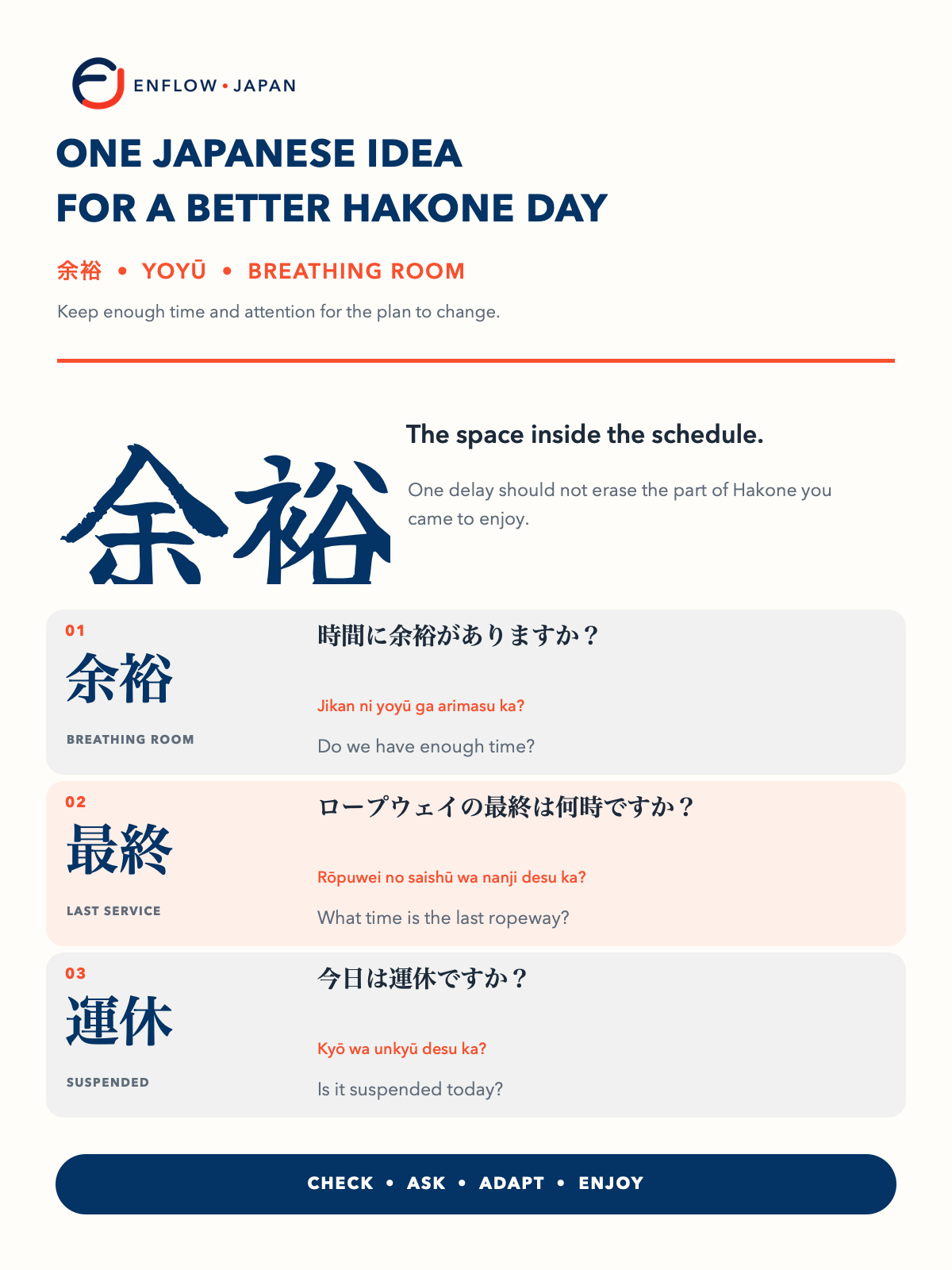
The phrase card is not a language test. Use one line when it solves a real problem.
時間に余裕がありますか?
Jikan ni yoyū ga arimasu ka? “Do we have enough time?”
Ask this when a guide, hotel staff member or station employee suggests adding another stop. The word 時間 (jikan) means time.
ロープウェイの最終は何時ですか?
Rōpuwei no saishū wa nanji desu ka? “What time is the last ropeway?”
最終 (saishū) means the last service. Use the live timetable for planning; use the question when you need to confirm what applies that day.
今日は運休ですか?
Kyō wa unkyū desu ka? “Is it suspended today?”
運休 (unkyū) means a scheduled transport service is not running. Pointing to the route name or map can make the question clearer.
You do not need fluent Japanese to visit Hakone. These lines are small tools for checking the plan, not an entrance requirement.
When one night is the better decision
Stay overnight when the point of the trip is not just the loop.
One night is usually the more honest choice if you want:
- an onsen without watching the return-train clock;
- a museum at a natural pace;
- morning or evening around Lake Ashi;
- a late departure from Tokyo;
- more tolerance for children, mobility needs or luggage; or
- two major indoor stops plus the mountain transport.
Odakyu's own pass page presents a one-night, two-day course alongside its day trip. That is useful context: the destination supports both styles, and neither is the universally “correct” Hakone.
Do not stay overnight only because the Freepass lasts two days. Stay because the extra evening and morning change the experience you want.
What a licensed guide actually adds
A guide does not make Hakone immune to weather or queues. The service is more specific:
- deciding which three or four places fit the day;
- navigating transfers with you;
- explaining history, customs and local context;
- adjusting the order when conditions change; and
- letting your group spend less attention on logistics.
That is valuable for some travelers and unnecessary for others.
The exact option checked for this guide was Hakone Customized Private Tour in 1 Day with Licensed Guide, product code 92136P197, supplied through Viator.
For July 31, 2026, two adults and English selected, the listing showed:
- a six-hour walking tour covering three to four sites for ¥53,000 total;
- an eight-hour version covering four to five sites for ¥58,000 total;
- multiple possible start times; and
- free cancellation until the displayed deadline, 24 hours before the checked option.
Those prices are dated context, not a promise. Group size, date, language, inventory and checkout control the live total.
The biggest detail to understand is what the tour is not. It meets guests on foot within Hakone. A private vehicle, transport fares, admission, lunch and personal expenses were not included in the checked listing.
That makes it a guided version of the public-transport experience—not a door-to-door car tour from Tokyo.
Disclosure: This article contains an affiliate link. If you book through it, ENFLOW JAPAN may earn a commission at no extra cost to you. The commission does not change our comparison, and the independent route remains fully available.
Check current availability for the licensed Hakone walking tour on Viator
Book it if
- your group wants cultural explanation, not just directions;
- one person would otherwise spend the day managing everyone else's route;
- you value a flexible human plan more than minimizing cost; and
- you understand that transport and admission remain separate.
Skip it if
- following the loop is part of the fun for you;
- your main goal is one museum or one onsen;
- you expect a private car from Tokyo; or
- the price would make you rush to “get your money's worth.”
Five checks before you leave
- Open the live transport-status page that morning.
- Mark one attraction as optional.
- Confirm the last useful connection for your route—not a generic “last train.”
- Recheck what a booked guide includes and where the meeting point is.
- Ask: 時間に余裕がありますか? If the honest answer is no, remove a stop.
The answer
Hakone can be a day trip. The official one-day course proves that.
But the best day trip is not the one that touches the most map pins. It is the one with enough 余裕 to keep a delay, a queue or a hidden Mount Fuji from becoming the story of the whole day.
Go independently if planning the loop sounds satisfying. Stay one night if onsen and unhurried time are the point. Book a licensed guide if you want interpretation and adaptive navigation—and you have confirmed exactly what the tour includes.
Follow ENFLOW JAPAN for practical Japan travel guidance checked against Japanese primary sources.
Sources checked
Where the key facts came from
Official transport information is separated from marketplace availability. All pages were re-opened on Jul 24, 2026 JST.